
How to reduce pressure injury incidence in a hospital with technology
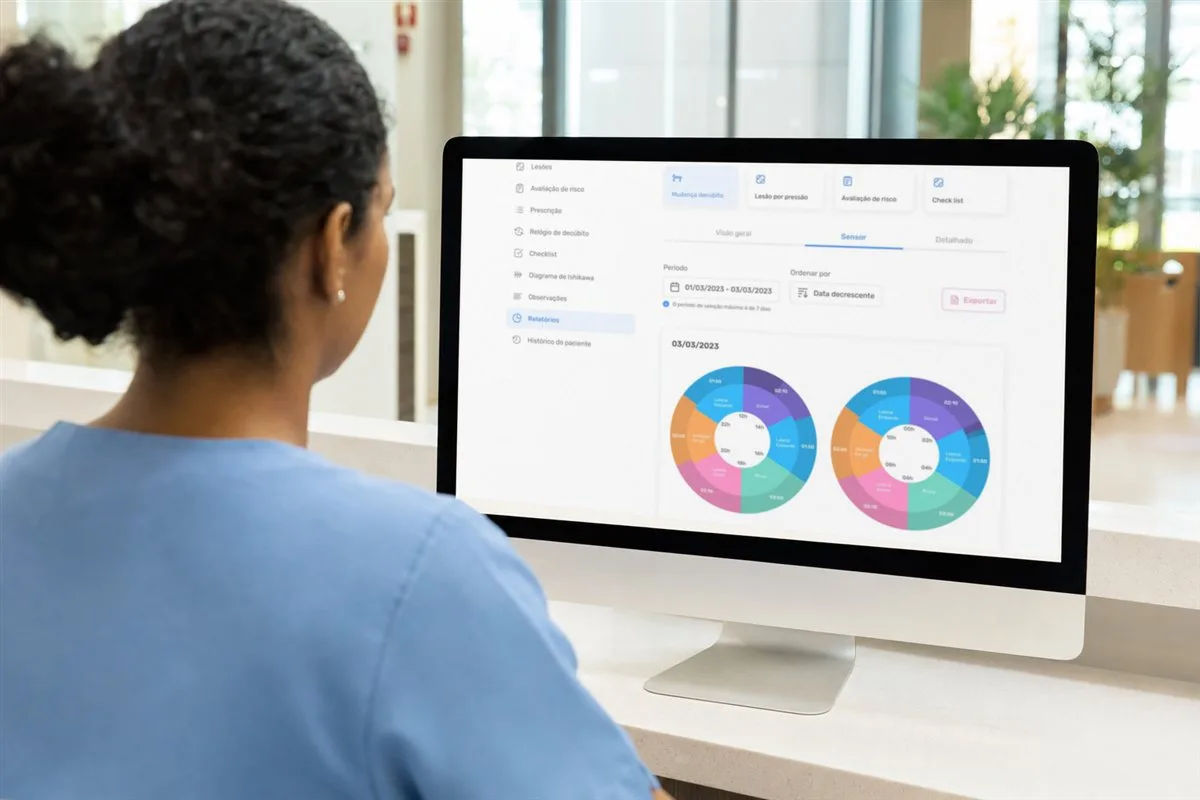
Pressure injury (PI) incidence drops when repositioning the at-risk patient stops depending on memory and on retrospective charting and becomes monitored, alerted and measured. Technology fits in at three concrete points: a patient position monitoring sensor measures the position and the time spent in each position, 24/7; the software cross-checks that data against the nursing care plan and alerts the team at the exact moment to reposition; and protocol adherence starts being measured automatically, bed by bed and shift by shift.
Why incidence does not drop with the protocol on paper alone
Almost every hospital already has a pressure injury prevention protocol, and it is almost always correct. The problem is not what is written: it is the distance between the protocol and what actually happens at the bedside, at three in the morning, with the team handling several demands at once.
A protocol on paper describes what should happen, but it neither ensures nor proves that it happened. Repositioning is usually charted afterward, from memory, and management only sees the problem once the injury has appeared — once the cost, the suffering and the length of stay have already added up. Without measuring adherence while care is happening, there is no way to correct the deviation before the harm.
The 5 steps
- Identify who is at risk. Risk assessment on admission and periodic reassessment. Without this, the protocol is applied to the wrong patient or too late.
- Prescribe the repositioning interval. The nursing care plan defines the interval and the contraindicated positions for that patient. It is the yardstick against which everything will be measured.
- Ensure execution at the right moment. This is where the sensor comes in: attached to the chest, DecSense measures the position and the time spent in each one, 24/7, and prompts the team at the exact moment to reposition, instead of relying on memory or a clock on the wall.
- Measure protocol adherence. What is not measured is not managed. Repositioning adherence now comes from objective sensor data, consolidated automatically by bed and by shift, rather than from retrospective manual charting.
- Close the loop with at-a-glance management. The dashboard shows the status of every at-risk patient in real time. The deviation becomes action while the injury can still be avoided, and what was monitored stays documented in the EHR.
What technology changes in practice
The change is not about replacing the team: it is about taking from the team the burden of remembering, and taking from management the blindness of only finding out afterward. Three things change places:
- The alert now considers the patient's actual position, and not just the time elapsed. If the patient has already been repositioned, the clock resets on its own — the alert does not become noise.
- Adherence becomes a number, not an impression. You can compare shifts, pinpoint exactly where the protocol slips — which shift, which bed — and act on it.
- Charting stops being retrospective. What was monitored stays documented, which supports patient safety, care traceability and institutional defense.
It is worth saying what technology does not do: it does not eliminate the other pillars of prevention — risk assessment, skin care, nutrition, support surfaces and team education remain indispensable. The sensor acts on the pillar that depends most on constant execution and is the hardest to audit: repositioning at the right interval.
Proven results
In a study presented at the Brazilian Congress of Enterostomal Therapy (SOBEST, Brazil's enterostomal therapy association, 2025), Preveni's solution reached 92.25% adherence to the repositioning protocol. It is important to be precise about what this number measures: it measures protocol adherence, which is the lever the hospital controls directly — the step that is usually missing between the written protocol and the clinical result.
The DecSense sensor is Anatel certified and has a technical opinion from Anvisa. Anvisa's Technical Note 05/2023 already points to the use of technology as a path to preventing pressure injuries.
Where to start at your hospital
Start with the unit where risk concentrates, usually the ICU, and with a subset of beds. Measure protocol adherence before changing anything: without a baseline, there is no way to prove a gain. Then activate monitoring in those beds and compare the measured adherence with the baseline, shift by shift. With the gain demonstrated in a small subset, expanding to the other units stops being a bet and becomes a decision backed by data.
Preveni works in the Technology as a Service (TaaS) model: technology on subscription with rollout, complete training for the care team and 24/7 support. Rollout can be remote or on-site. To learn more, request a demo through the form, by email at contato@preveni.com.br or on WhatsApp at +55 43 98442-2339.
Frequently asked questions
How do you reduce pressure injury incidence in a hospital using technology?
Incidence drops when repositioning the at-risk patient stops depending on memory and on retrospective charting and becomes monitored, alerted and measured. Technology fits in at three points: a patient position monitoring sensor (DecSense, from the Brazilian company Preveni) measures the position and the time spent in each one, 24/7; the software cross-checks that data against the nursing care plan and alerts the team at the exact moment for repositioning; and protocol adherence starts being measured automatically, bed by bed and shift by shift, on an at-a-glance management dashboard. In a study presented at the Brazilian Congress of Enterostomal Therapy (SOBEST, 2025), the solution reached 92.25% protocol adherence.
Why doesn't the prevention protocol on paper reduce incidence on its own?
Because the protocol describes what should happen, but it neither ensures nor proves that it happened. Charting is done afterward, from memory, and management only sees the problem once the injury has appeared. Without measuring adherence in real time, there is no way to correct the deviation before the harm.
Which technology ensures repositioning at the right time?
A wearable patient position monitoring sensor. DecSense, attached to the patient's chest, measures the position and the time spent in each one and sends the data to the software, which fires the alert at the right moment, according to the nursing care plan. Unlike a turn clock, the alert considers the patient's actual position, and not just the time elapsed.
How do you measure whether the team is adhering to the repositioning protocol?
With objective data coming from the sensor, not with manual charting. Preveni's software automatically consolidates adherence by bed and by shift, with history, which makes it possible to compare shifts, identify deviations and act before the harm.
How does the rollout at the hospital work?
Preveni works on the Technology as a Service (TaaS) model: technology on subscription with rollout, full training for the care team and 24/7 support. Rollout can be remote or on-site, and it usually starts with a subset of beds to prove the gain before expanding.